FREE SHIPPING OVER 60 € | ✉ SIGN UP & SAVE 10 %
BREZPLAČNA POŠTNINA NAD 60 € | ✉ PRIJAVI SE IN PRIHRANI 10 %

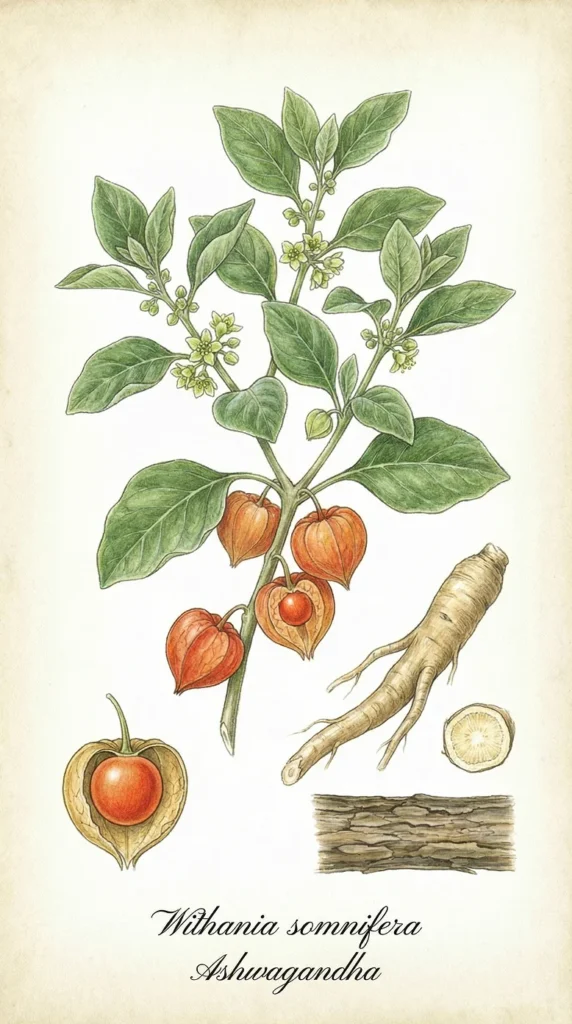
Ayurveda describes ashwagandha as “the herb that has the strength of a horse,” symbolizing power, endurance, and fertility.
In the last two decades, ashwagandha has become one of the most researched adaptogenic herbs, primarily studied for its role in reducing stress and anxiety, improving sleep, enhancing cognitive functions, boosting athletic performance, and supporting metabolism. It is often used as a tonic for the reproductive system and to support sexual vitality in both men and women.
In Ayurveda, Withania somnifera is classified as:
Doshas: specifically reduces Vata dosha, balances Kapha, and with proper use does not increase Pitta.
Classical Ayurvedic texts recommend ashwagandha for:
In traditional use, the root is most commonly used, often combined with ghee, honey, or warm milk.
Ashwagandha contains a rich array of bioactive compounds, the most important of which include:
Withanolides are structurally similar to steroid hormones and can act as modulators of signaling pathways involved in inflammation, oxidative stress, and cell death (apoptosis).
The most extensively researched benefit of ashwagandha is its effect on stress. Several randomized, double-blind, placebo-controlled studies have shown that standardized root extracts of ashwagandha can:
Meta-analyses of clinical trials confirm its effectiveness in reducing stress and anxiety.
Ashwagandha has traditionally been used as a tonic for the nervous system. Randomized studies in people with mild cognitive impairment or in healthy adults have demonstrated improvements in working memory, executive function, reaction time, and overall cognitive performance. Some studies have also observed better attention and learning capacity.
Preclinical research suggests that withanolides protect neurons from oxidative stress and glutamate toxicity, and they stimulate neuroplasticity (the growth of dendrites and formation of new synaptic connections).
In recent years, ashwagandha has been increasingly used in sports and fitness. Supplementation with root extract has been found to increase maximal strength, improve VO₂max and endurance, shorten recovery time, and reduce muscle soreness after exercise.
Scientific studies confirm that ashwagandha acts as an immunomodulator:
Preclinical data indicate potential oncoprotective (anti-cancer) effects. In laboratory studies, withaferin A and related withanolides induce apoptosis (programmed cell death) in tumor cells and inhibit angiogenesis (blood vessel formation) and metastasis in various tumor models (including breast, colon, and lung cancers, as well as hematological malignancies).
Most clinical studies demonstrate that ashwagandha is safe to take, with only rare and mild side effects reported:
Sedatives and anti-anxiety medications: Ashwagandha may have an additive sedative effect when taken with sedatives, benzodiazepines, or other GABAergic drugs, so use caution when combining them.
Thyroid medications: Ashwagandha can increase thyroid hormone levels. If used alongside thyroid medications, it may enhance their effects, requiring dose adjustments and careful laboratory monitoring.
Immunosuppressants: Because of its immunomodulatory effects, ashwagandha could theoretically interfere with immunosuppressive therapy, so caution is warranted when combining them.
Chandrasekhar, K., Kapoor, J., & Anishetty, S. (2012). A prospective, randomized double-blind, placebo-controlled study of safety and efficacy of a high-concentration full-spectrum extract of Ashwagandha root in reducing stress and anxiety in adults. Indian Journal of Psychological Medicine, 34(3), 255–262.
Choudhary, D., Bhattacharyya, S., & Bose, S. (2017). Efficacy and safety of ashwagandha (Withania somnifera (L.) Dunal) root extract in improving memory and cognitive functions. Journal of Dietary Supplements, 14(6), 599–612.
Dar, N. J., & Ahmad, M. (2020). Withania somnifera: Current perspectives on therapeutic potentials. Alternative Therapies in Health and Medicine, 26(1), 20–31.
Dubey, S., et al. (2021). Efficacy of Withania somnifera supplementation on stress, sleep, and quality of life: A systematic review and meta-analysis of randomized controlled trials. Phytotherapy Research, 35(9), 1–15.
Kelgane, S. B., Salve, J., Sampara, P., & Debnath, K. (2020). Efficacy and safety of ashwagandha root extract in insomnia and anxiety: A double-blind, randomized, placebo-controlled study. Cureus, 12(10), e11785.
Lopresti, A. L., Drummond, P. D., & Smith, S. J. (2019). A randomized, double-blind, placebo-controlled, crossover study examining the hormonal and vitality effects of ashwagandha (Withania somnifera) in aging, overweight males. American Journal of Men’s Health, 13(2), 1557988319835985.
Raut, A. A., Rege, N. N., Tadvi, F. M., Solanki, P. V., Kene, K. R., Shirolkar, S. G., & Vaidya, A. B. (2012). Exploratory study to evaluate tolerability, safety, and activity of ashwagandha (Withania somnifera) in healthy volunteers. Journal of Ayurveda and Integrative Medicine, 3(3), 111–114.
Salve, J., Pate, S., Debnath, K., & Langade, D. (2019). Adaptogenic and anxiolytic effects of ashwagandha root extract in healthy adults: A double-blind, randomized, placebo-controlled clinical study. Cureus, 11(12), e6466.
Sharma, M., & Chandola, H. M. (2011). Withania somnifera (Ashwagandha) in Ayurveda: A review of pharmacological and clinical studies. AYU, 32(1), 72–79.
Singh, N., Bhalla, M., de Jager, P., & Gilca, M. (2011). An overview on ashwagandha: A Rasayana (rejuvenator) of Ayurveda. African Journal of Traditional, Complementary and Alternative Medicines, 8(5 Suppl), 208–213.
Tripathi, A. K., et al. (2018). Effect of Withania somnifera on subclinical hypothyroidism: A double-blind, randomized, placebo-controlled trial. Journal of Alternative and Complementary Medicine, 24(3), 243–248.
Wankhede, S., Langade, D., Joshi, K., Sinha, S. R., & Bhattacharyya, S. (2015). Examining the effect of Withania somnifera supplementation on muscle strength and recovery: A randomized controlled trial. Journal of the International Society of Sports Nutrition, 12, 43.
(subscription – regular delivery every 30 / 60 / 90 days)